Home-Based Senior Care to Become a Multi-Billion-Baht Megatrend Within Five Years
Last updated: 25 Jun 2026
1064 Views
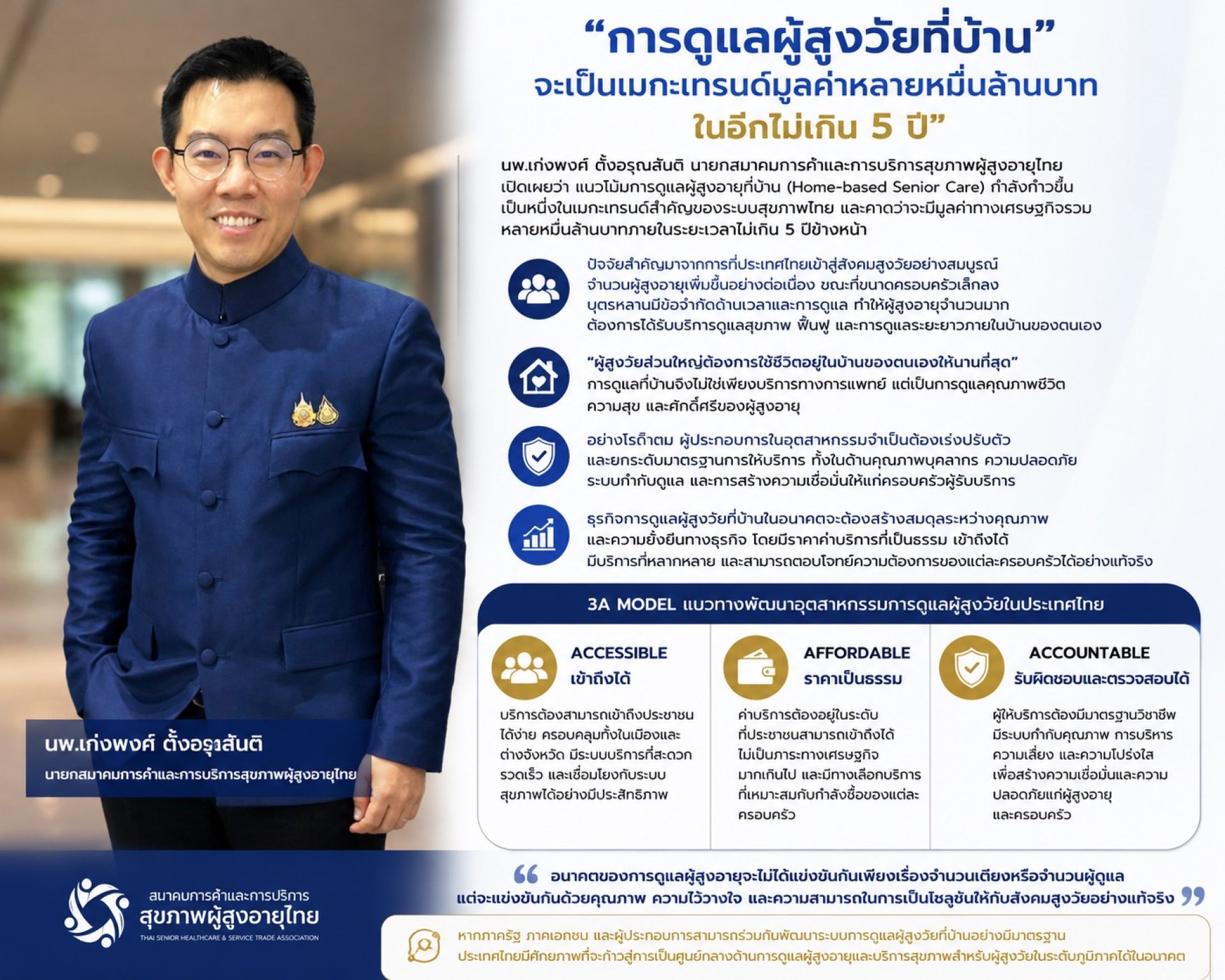
Dr. Gengpong Tangaroonsanti, President of the Thai Senior Healthcare and Trade Association (SHSTA), believes that home-based senior care is rapidly emerging as one of Thailand’s most important healthcare megatrends and is expected to generate a market value worth tens of billions of baht within the next five years.
Content Details (EN)
Dr. Gengpong Tangaroonsanti, President of the Thai Senior Healthcare and Trade Association (SHSTA), stated that Home-Based Senior Care is becoming one of the most significant emerging trends in Thailand’s healthcare sector and is projected to create an economic market worth tens of billions of baht within the next five years.
The growth is primarily driven by Thailand’s transition into a fully aged society. As the number of older adults continues to rise and family sizes become smaller, many families face increasing challenges in providing daily care for aging parents and relatives. As a result, demand for healthcare services, rehabilitation, and long-term care at home is growing rapidly.
“Most older adults prefer to remain in their own homes for as long as possible. Home-based care is not only about medical support; it is about preserving quality of life, happiness, independence, and dignity.”
However, industry operators must continue to improve service standards by investing in workforce development, patient safety, quality assurance systems, and trust-building measures for families seeking care services.
Dr. Gengpong emphasized that the future of home-based senior care must balance service quality with business sustainability. Care services should be accessible, affordable, and flexible enough to meet the unique needs of different families.
The 3A Model for Thailand’s Senior Care Industry
Accessible
Care services should be easy to access across both urban and rural areas, supported by efficient service systems and strong integration with healthcare networks.
Affordable
Service fees should remain within reach for the general population, offering suitable care options that match the financial capabilities of different households.
Accountable
Care providers must operate under professional standards with clear quality control systems, risk management practices, and transparency to ensure safety and trust for seniors and their families.
“The future of elderly care will not be defined by the number of beds or caregivers available. Success will be determined by quality, trust, and the ability to provide meaningful solutions for an aging society.”
Dr. Gengpong further noted that if government agencies, private organizations, and healthcare providers collaborate to establish high standards for home-based senior care, Thailand has the potential to become a regional hub for elderly care and senior healthcare services in Asia.
Content Details (EN)
Dr. Gengpong Tangaroonsanti, President of the Thai Senior Healthcare and Trade Association (SHSTA), stated that Home-Based Senior Care is becoming one of the most significant emerging trends in Thailand’s healthcare sector and is projected to create an economic market worth tens of billions of baht within the next five years.
The growth is primarily driven by Thailand’s transition into a fully aged society. As the number of older adults continues to rise and family sizes become smaller, many families face increasing challenges in providing daily care for aging parents and relatives. As a result, demand for healthcare services, rehabilitation, and long-term care at home is growing rapidly.
“Most older adults prefer to remain in their own homes for as long as possible. Home-based care is not only about medical support; it is about preserving quality of life, happiness, independence, and dignity.”
However, industry operators must continue to improve service standards by investing in workforce development, patient safety, quality assurance systems, and trust-building measures for families seeking care services.
Dr. Gengpong emphasized that the future of home-based senior care must balance service quality with business sustainability. Care services should be accessible, affordable, and flexible enough to meet the unique needs of different families.
The 3A Model for Thailand’s Senior Care Industry
Accessible
Care services should be easy to access across both urban and rural areas, supported by efficient service systems and strong integration with healthcare networks.
Affordable
Service fees should remain within reach for the general population, offering suitable care options that match the financial capabilities of different households.
Accountable
Care providers must operate under professional standards with clear quality control systems, risk management practices, and transparency to ensure safety and trust for seniors and their families.
“The future of elderly care will not be defined by the number of beds or caregivers available. Success will be determined by quality, trust, and the ability to provide meaningful solutions for an aging society.”
Dr. Gengpong further noted that if government agencies, private organizations, and healthcare providers collaborate to establish high standards for home-based senior care, Thailand has the potential to become a regional hub for elderly care and senior healthcare services in Asia.
Related Content
Vaccination is one of the most effective preventive healthcare measures for older adults. As the immune system gradually declines with age, seniors become more vulnerable to infectious diseases and their complications. Understanding the recommended vaccines can help reduce hospitalization, disability, and mortality while supporting healthy aging and longevity.
17 Jun 2026
ปอดบวมเป็นภาวะที่ถุงลมในปอดเกิดการอักเสบและติดเชื้อ ซึ่งอาจเกิดจากเชื้อแบคทีเรีย ไวรัส หรือเชื้อรา โรคปอดบวมสามารถเกิดขึ้นได้กับทุกเพศทุกวัย แต่ผู้สูงอายุเป็นกลุ่มเสี่ยงที่มีโอกาสป่วยเป็นโรคปอดบวมมากกว่ากลุ่มอื่น เนื่องจากมีระบบภูมิคุ้มกันที่อ่อนแอลงตามวัย
19 Mar 2025
Effective rehabilitation is not only about recovering from illness but also about restoring independence, mobility, and quality of life. At Chersery Home International, our multidisciplinary rehabilitation team provides personalized care designed to help patients regain confidence and return to daily activities safely.
16 Jun 2026
