4 Easy Exercises to Build Muscle Mass for Older Adults and Reduce Fall Risk
Last updated: 1 Jun 2026
2683 Views
4 Easy Exercises to Build Muscle Mass for Older Adults
“Stronger muscles, better balance, fewer falls, and greater independence.”
As we age, muscle mass gradually decreases due to a condition known as Sarcopenia. This can result in reduced strength, slower mobility, fatigue, and a higher risk of falls.
The good news is that regular exercise can help slow down muscle loss and even rebuild muscle strength. With just 10–15 minutes a day, these exercises can be performed safely at home using only a sturdy chair.
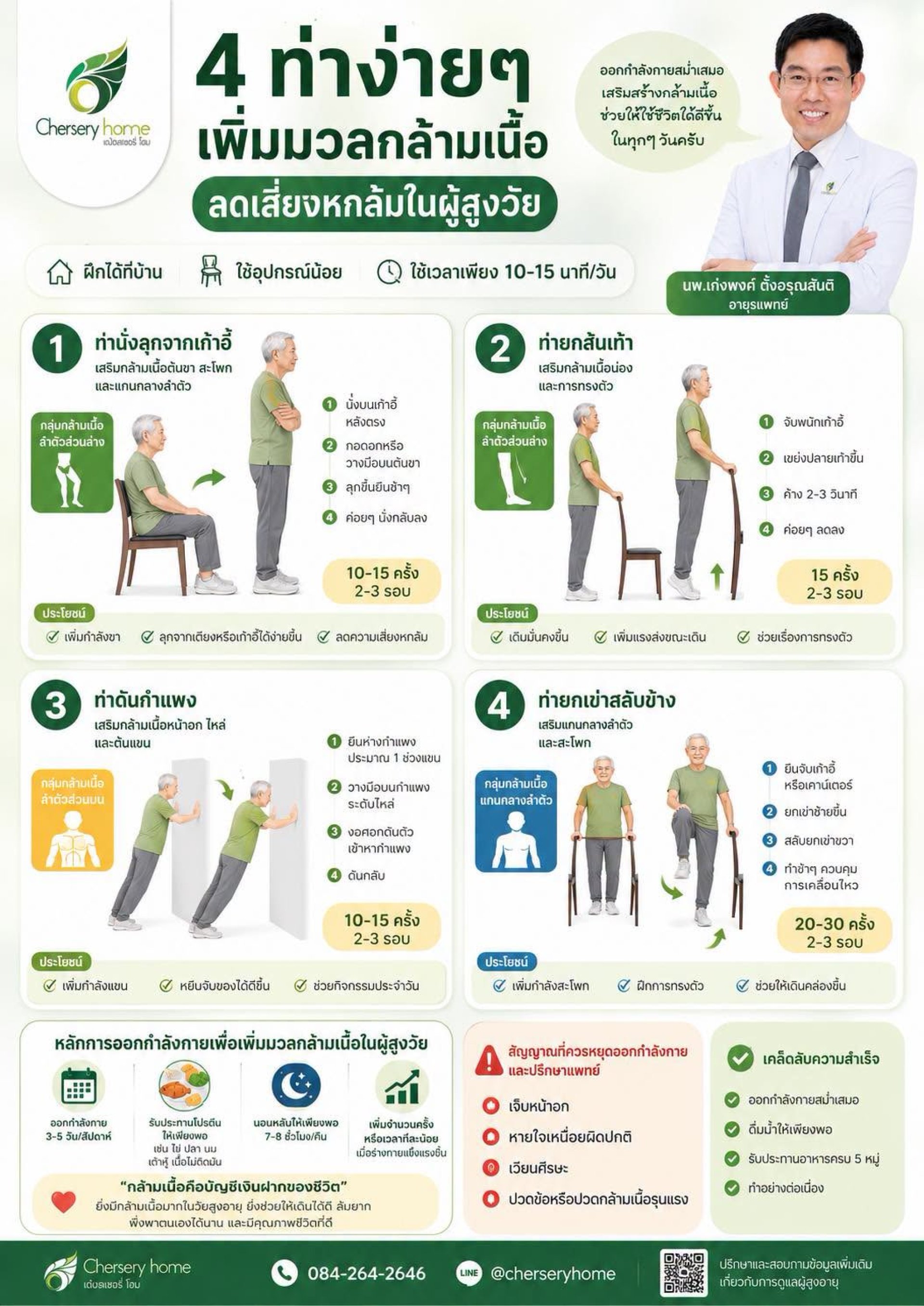
Chair Sit-to-Stand
Strengthens the thighs, hips, and core muscles.
How to Perform:
• Sit on a sturdy chair with your arms crossed over your chest or resting on your thighs.
• Slowly stand up.
• Gradually sit back down.
• Repeat 10–15 times for 2–3 sets.
Benefits:
• Increases leg strength
• Improves the ability to sit and stand independently
• Reduces fall risk
Heel Raise
Strengthens the calf muscles and improves balance.
How to Perform:
• Hold onto the back of a chair.
• Rise onto your toes.
• Hold for 2–3 seconds.
• Slowly lower your heels.
• Repeat 15 times for 2–3 sets.
Benefits:
• Enhances walking stability
• Improves push-off strength while walking
• Supports better balance
Wall Push-Up
Strengthens the chest, shoulders, and upper arms.
How to Perform:
• Stand about an arm’s length away from a wall.
• Place your hands on the wall.
• Bend your elbows and lean toward the wall.
• Push yourself back to the starting position.
• Repeat 10–15 times for 2–3 sets.
Benefits:
• Builds upper body strength
• Improves the ability to lift and carry objects
• Supports daily activities
Marching in Place
Strengthens the core and hip muscles.
How to Perform:
• Stand while holding onto a chair or countertop.
• Lift your left knee.
• Alternate with your right knee.
• Move slowly and maintain control.
• Repeat 20–30 times.
Benefits:
• Strengthens the hips
• Improves balance and coordination
• Enhances walking ability
Key Principles for Building Muscle
• Exercise 3–5 days per week
• Consume adequate protein from foods such as eggs, fish, milk, tofu, and lean meats
• Get 7–8 hours of sleep each night
• Gradually increase repetitions and intensity over time
When to Stop Exercising and Consult a Doctor
• Chest pain
• Unusual shortness of breath
• Dizziness
• Severe joint or muscle pain
“Muscle is a lifelong investment.”
The more muscle mass we maintain as we age, the better we can move, prevent falls, remain independent, and enjoy a higher quality of life.
Dr. Kengpong Tangarunsanti
Internal Medicine Physician
Chersery Home International
Tel. +66 84-264-2646
“Stronger muscles, better balance, fewer falls, and greater independence.”
As we age, muscle mass gradually decreases due to a condition known as Sarcopenia. This can result in reduced strength, slower mobility, fatigue, and a higher risk of falls.
The good news is that regular exercise can help slow down muscle loss and even rebuild muscle strength. With just 10–15 minutes a day, these exercises can be performed safely at home using only a sturdy chair.
Chair Sit-to-Stand
Strengthens the thighs, hips, and core muscles.
How to Perform:
• Sit on a sturdy chair with your arms crossed over your chest or resting on your thighs.
• Slowly stand up.
• Gradually sit back down.
• Repeat 10–15 times for 2–3 sets.
Benefits:
• Increases leg strength
• Improves the ability to sit and stand independently
• Reduces fall risk
Heel Raise
Strengthens the calf muscles and improves balance.
How to Perform:
• Hold onto the back of a chair.
• Rise onto your toes.
• Hold for 2–3 seconds.
• Slowly lower your heels.
• Repeat 15 times for 2–3 sets.
Benefits:
• Enhances walking stability
• Improves push-off strength while walking
• Supports better balance
Wall Push-Up
Strengthens the chest, shoulders, and upper arms.
How to Perform:
• Stand about an arm’s length away from a wall.
• Place your hands on the wall.
• Bend your elbows and lean toward the wall.
• Push yourself back to the starting position.
• Repeat 10–15 times for 2–3 sets.
Benefits:
• Builds upper body strength
• Improves the ability to lift and carry objects
• Supports daily activities
Marching in Place
Strengthens the core and hip muscles.
How to Perform:
• Stand while holding onto a chair or countertop.
• Lift your left knee.
• Alternate with your right knee.
• Move slowly and maintain control.
• Repeat 20–30 times.
Benefits:
• Strengthens the hips
• Improves balance and coordination
• Enhances walking ability
Key Principles for Building Muscle
• Exercise 3–5 days per week
• Consume adequate protein from foods such as eggs, fish, milk, tofu, and lean meats
• Get 7–8 hours of sleep each night
• Gradually increase repetitions and intensity over time
When to Stop Exercising and Consult a Doctor
• Chest pain
• Unusual shortness of breath
• Dizziness
• Severe joint or muscle pain
“Muscle is a lifelong investment.”
The more muscle mass we maintain as we age, the better we can move, prevent falls, remain independent, and enjoy a higher quality of life.
Dr. Kengpong Tangarunsanti
Internal Medicine Physician
Chersery Home International
Tel. +66 84-264-2646
Related Content
Quality rehabilitation requires more than medical treatment alone. It depends on a dedicated nursing team that provides continuous care, close monitoring, and compassionate support throughout every stage of recovery. Discover the six essential roles of our nursing team and how Chersery Home International delivers world-class senior care and rehabilitation under AACI international standards.
15 Jun 2026
Strong leg muscles are essential for maintaining mobility, balance, and independence in older adults. Discover three simple daily exercises that can help improve leg strength, reduce the risk of falls, and support healthy aging.
9 Jun 2026
ฝึกการหายใจเข้าออกลึกๆ
ให้ผู้ป่วยนั่งตัวตรงที่ข้างเตียง หรือช่วยให้อยู่ในท่านอนศีรษะสูง (Semi-Fowler’s position) โดยใช้มือทั้ง 2 ข้างจับที่ท้อง ให้สูดลมหายใจเข้าทางจมูกช้าๆ ลึกๆ จนรู้สึกว่าหน้าท้องขยายตัว/ท้องป่อง แล้วค่อยๆ ผ่อนลมหายใจออกทางปากช้าๆ เบาๆ จนรู้สึกว่ากล้ามเนื้อหน้าท้องหดตัว/ท้องแฟบ แนะนำให้ปฏิบัติบ่อยๆ เท่าที่จะทำได้อย่างน้อย 5-10 ครั้ง ทุกชั่วโมง
19 Mar 2025
